
Most electric light trucks use two battery packs mounted on either side of the chassis. A different layout is now emerging: one larger battery pack installed in the central section of the frame.
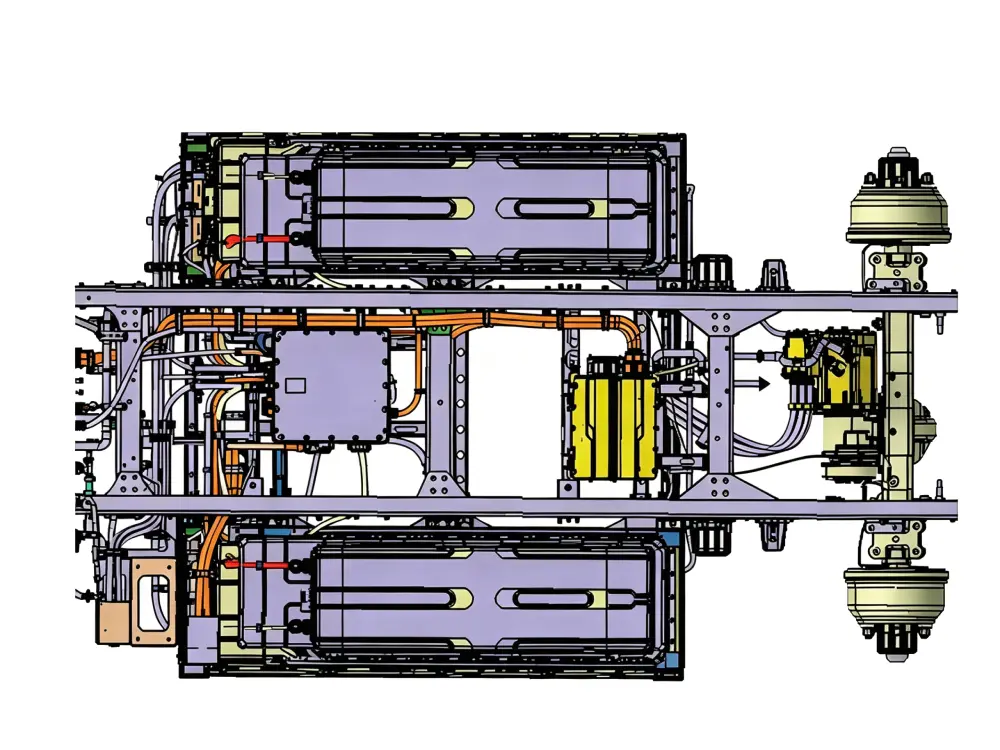
The difference goes beyond the number of battery packs. An electric light truck battery layout affects vehicle weight, chassis packaging, high-voltage cable routing, available space for auxiliary equipment, and compatibility with the electric drivetrain. A single-pack design can offer packaging and weight advantages, but it may also require changes to chassis dimensions and powertrain configuration.
This article compares single-pack and dual-pack battery layouts for electric light trucks, focusing on their structural differences, potential advantages, and engineering considerations for EV manufacturers and vehicle engineering companies.
1. Electric Light Truck Battery Layout: What Is the Difference Between Single-Pack and Dual-Pack Designs?
In a conventional dual-pack battery layout, two battery packs are mounted along the left and right sides of the chassis. This arrangement distributes the battery system across the available frame space and is commonly used in electric light trucks.
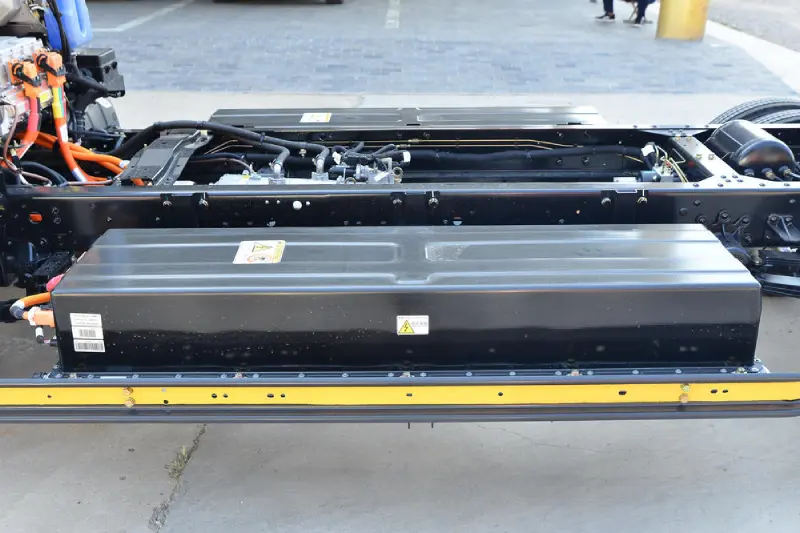
A single-pack battery layout consolidates the battery system into one enclosure, typically positioned in the central section of the chassis. This approach involves more than combining two packs into one. Battery modules, cooling structures, electrical connections, the enclosure, and mounting points may all need to be redesigned around the available space.
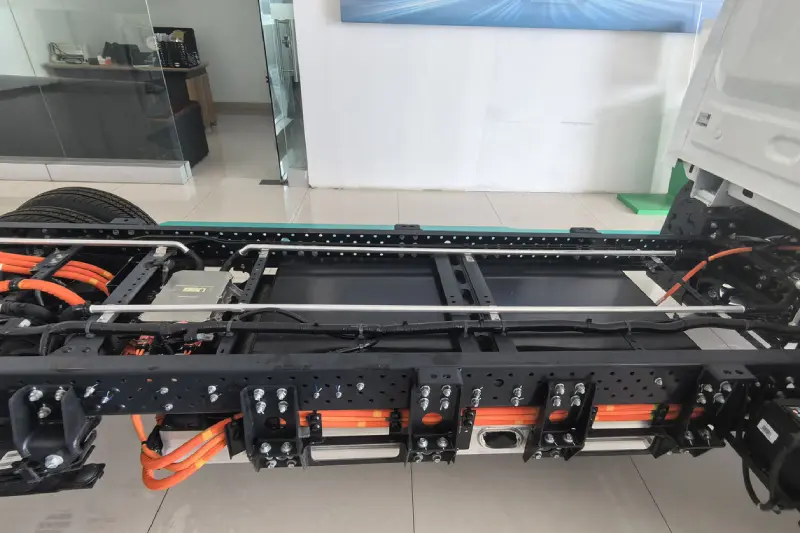
The main differences between the two electric light truck battery layouts are summarized below.
| Design consideration | Dual-pack battery layout | Single-pack battery layout |
|---|---|---|
| Battery position | Along both sides of the chassis | Central section of the chassis |
| Pack structure | Two separate battery assemblies | One integrated battery assembly |
| High-voltage wiring | May require longer interconnections | May allow shorter cable routing |
| Mounting structure | Often requires multiple side-mounted brackets | May use a more integrated mounting arrangement |
| Chassis-side space | Partly occupied by battery packs | More space may be available for toolboxes |
| Chassis packaging | Depends on pack dimensions and mounting points | May require greater frame width |
| Drivetrain compatibility | Depends on the overall vehicle architecture | May impose additional packaging constraints |
These differences depend on the actual battery and chassis design. Neither layout is inherently better for every electric light truck application.
2. Four Advantages of a Single-Pack Electric Light Truck Battery Layout
2.1 Fewer Separate Assemblies and Simpler Integration
A single-pack electric light truck battery layout can reduce the number of separate battery enclosures and associated interfaces. Depending on the design, it may also simplify cooling connections, high-voltage wiring, and mounting structures.
Fewer separate assemblies can reduce the number of connections and interfaces that need to be installed and inspected. However, component count alone does not determine system reliability. Battery quality, thermal management, electrical protection, fault isolation, and structural design remain important.
2.2 Lower Battery-System Weight at the Same Capacity
An integrated battery pack may reduce the weight of enclosures, mounting brackets, and interconnecting components. The actual benefit depends on cell chemistry, pack structure, cooling hardware, and protective requirements.
For the 100 kWh configuration described in the source material, the reported figures are:
| Parameter | Dual-pack layout | Single-pack layout |
|---|---|---|
| Battery-system specific energy | 130–150 Wh/kg | 150–160 Wh/kg |
| Battery-system weight | Approx. 670–770 kg | Approx. 625–670 kg |
| Vehicle curb weight | Approx. 3.2 tonnes | Approx. 3.1 tonnes |
These figures represent a specific configuration rather than standard values for all electric light trucks. They should be verified against the relevant vehicle and battery specifications before being used as product claims.
Reducing battery-system weight can increase the payload available within a fixed gross vehicle weight rating (GVWR). Shorter high-voltage cables may also reduce electrical losses, although the benefit depends on cable length, cross-section, current, and system design.
2.3 More Flexibility in Battery Protection
A centrally mounted battery pack can sit farther from the outer sides of the vehicle than side-mounted battery packs. This creates an opportunity to incorporate side-protection structures between the battery and potential impact areas.
The actual safety benefit depends on the chassis frame, battery enclosure, side underrun protection, mounting structure, and crash-energy management. Central placement alone does not guarantee better crash performance; the complete structure requires appropriate engineering assessment and validation.
2.4 More Space Along the Chassis Sides
In a dual-pack electric light truck battery layout, the battery packs may occupy space that could otherwise accommodate toolboxes or auxiliary equipment.
A central single-pack arrangement can free up some of this space, depending on the frame and body configuration. This can be useful for delivery vehicles that need to carry tools, tarpaulins, rain covers, or other operational equipment.
3. Limitations of a Single-Pack Electric Light Truck Battery Layout
3.1 Drivetrain Compatibility and Unsprung Mass
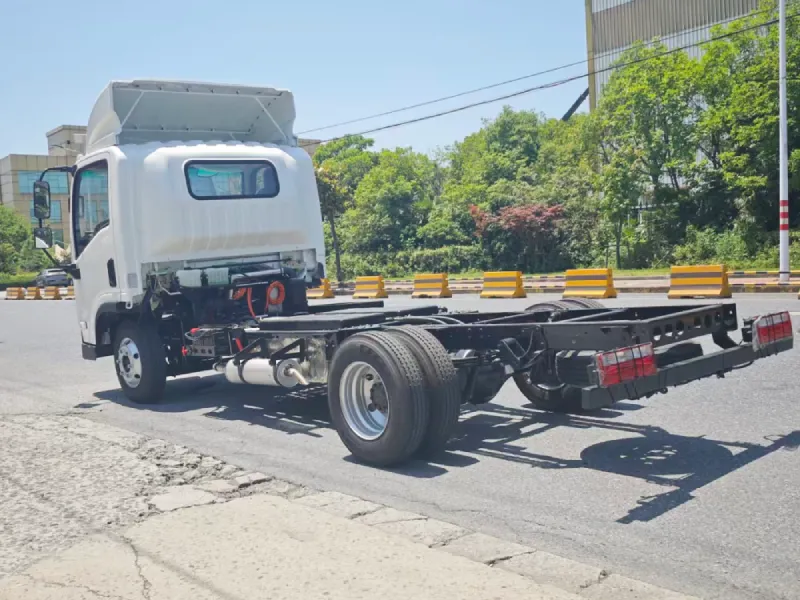
The single-pack design described in the source material is intended for a vehicle using an electric drive axle rather than a centrally mounted motor and transmission. This is a constraint of that particular vehicle architecture, not a universal limitation of all single-pack battery layouts.
An electric drive axle integrates the motor and transmission into the axle assembly, which can simplify the driveline arrangement. However, the additional mass carried by the axle can increase unsprung mass and affect ride comfort, wheel contact, and component loading on uneven roads.
For electric light trucks operating mainly on urban roads and highways, an electric drive axle may be appropriate. Vehicles intended for rough rural roads or construction sites need a closer assessment of axle durability, suspension performance, and powertrain protection.
The battery layout and drivetrain should therefore be evaluated together rather than as independent design choices.
3.2 Chassis Width and Structural Requirements
A central battery pack may require more space across the chassis frame than an existing platform can provide. The source material identifies a potential frame width of 860–900 mm for its single-pack configuration, compared with approximately 800–850 mm for some conventional 4.2 m diesel light trucks.
These dimensions are specific reference values, not universal requirements. Actual clearance depends on the battery enclosure, mounting points, suspension, axle arrangement, and body design.
If a conventional diesel chassis cannot accommodate the battery pack, modifications may be needed to the frame, axle mounting points, suspension geometry, and other interfaces. Such changes can affect structural strength, handling, ride comfort, and durability, requiring appropriate analysis and vehicle-level testing.
For this reason, the electric light truck battery layout should be established early in platform development. Designing the chassis around the battery and drivetrain requirements can provide more packaging flexibility than adapting an existing diesel platform without sufficient allowance.
4. How to Choose an Electric Light Truck Battery Layout
The choice between single-pack and dual-pack battery layouts should reflect the complete vehicle specification.
- Payload and vehicle weight: Compare the total mass of the battery, mounting structure, cooling system, wiring, and protective components against the vehicle’s GVWR and payload target.
- Chassis packaging: Check frame width, battery clearance, ground clearance, axle positions, suspension travel, and body mounting space.
- Drivetrain architecture: Confirm compatibility with the intended motor, transmission, or electric drive axle.
- Operating conditions: Assess urban delivery, highway operation, uneven rural roads, and construction-site use separately.
- Battery safety and thermal management: Evaluate enclosure protection, cooling performance, electrical isolation, mounting strength, and crash-related requirements.
- Auxiliary equipment: Determine whether the chassis needs space for toolboxes, refrigeration equipment, or specialized cargo bodies.
- Development and validation costs: Consider engineering changes, tooling, testing, and manufacturing implications alongside the battery-system cost.
Conclusion: Which Electric Light Truck Battery Layout Is Better?
A single-pack electric light truck battery layout can reduce battery-system weight and free up chassis-side space when the battery, chassis, and drivetrain are designed as an integrated system. It may be particularly attractive for new urban delivery vehicle platforms with clearly defined packaging and payload requirements.
A dual-pack layout can remain a practical option when the existing chassis architecture, component placement, or drivetrain requirements favor batteries mounted along the frame sides.
The final decision should be based on battery capacity, payload targets, chassis dimensions, drivetrain compatibility, road conditions, and safety validation. For EV manufacturers and engineering companies, the key is to select the battery layout as part of the overall vehicle architecture rather than treating it as an isolated battery-pack decision.
Jenwyn Tech supplies electric truck chassis, integrated electric drive systems, eAxles, traction motors, and other key components for commercial EV platforms. Our engineering design capabilities also support project-specific chassis and powertrain requirements. For teams developing a new electric light truck or adapting a platform for electrification, these systems and components provide a starting point for evaluating packaging, drivetrain configuration, and component compatibility.
Contact Jenwyn Tech to discuss your electric light truck project and component requirements.
👉You can contact our team at contact@jenwyntech.com or complete the form below.