
Mining truck electrification is becoming a practical option for mining operators looking to reduce diesel consumption, control operating costs and extend the service life of existing equipment.
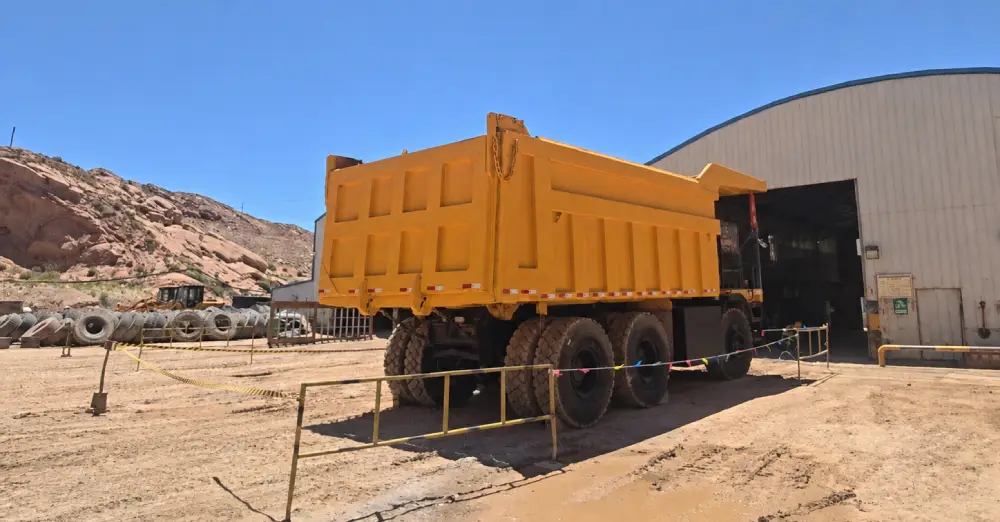
For an older mining dump truck with a structurally sound chassis, electrification does not necessarily require replacing the complete vehicle. The existing truck can be upgraded by replacing the diesel powertrain with a battery-electric system while retaining major components such as the drive axle, suspension, tires and dump body.
However, the economics of mining truck electrification depend heavily on the actual duty cycle. Payload, haul distance, road gradient and regenerative braking opportunities can all affect energy consumption and operating costs.
This case study examines the electrification of a 45-ton mining dump truck at a cement mine and compares its performance and energy consumption under different haul conditions.
1. Mining Truck Electrification Approach
The original vehicle was a 45-ton diesel mining dump truck equipped with a conventional engine and transmission system.
| Item | Before Electrification | After Electrification | Remarks |
|---|---|---|---|
| Curb Weight | 33,980 kg | ≤34,000 kg | |
| Rated Payload | 45,000 kg | 45,000 kg | |
| Maximum Speed | 66 km/h | 66 km/h | |
| Engine Net Power | 368 kW, 2,100 r/min | / | |
| Max. Engine Torque | 2,440 N.m | / | |
| Traction Motor Rated Power | / | 350 kW | |
| Traction Motor Braking Power | / | 580 kW | |
| Traction Motor Drive Torque | / | 9,218 – 9,760 N.m | |
| Overall Vehicle Dimensions | 8,875*4,240*4,245 mm | 8,875*4,240*4,245 mm | |
| Maximum Gradeability at Full Load | ≥20% | ≥20% | |
| Stable Speed on 8% Grade | 13.5 km/h | 13.5 km/h | Uphill |
| Mechanical Braking Performance | Drum brake (ISO 3450) | Drum brake (ISO 3450) | Actuator Unchanged |
| Electric Braking Performance | / | Complies with GB/T 35196 | Dual Braking Redundancy |
| Battery Capacity | / | 370 kWh | Meets the requirements for 8-hour continuous operation under heavy-load downhill conditions on a 4% grade |
For the electrification project, the original engine, transmission and related drivetrain components were removed and replaced with an electric powertrain system, including:
- Traction battery
- Traction motor
- Motor controller
- Auxiliary electric motors
- DC/DC converter
- Electric air compressor
- Electric steering pump
- Electric hydraulic pump
- Thermal management system
- Vehicle control and CAN system
The original drive axle, suspension, tires and dump body were retained. The chassis and cab were adapted for the electric system.
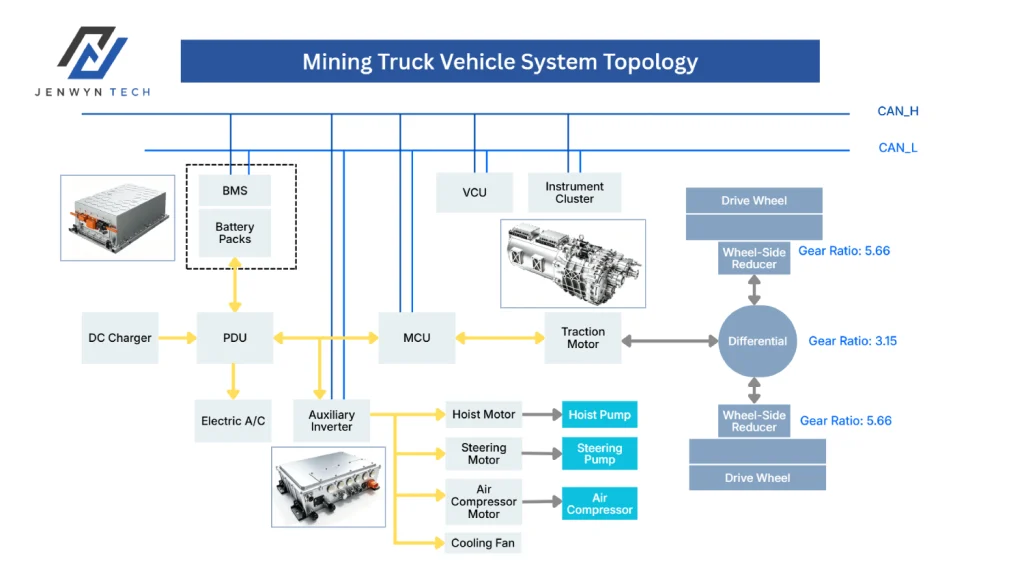
The design objective was to maintain the vehicle’s operating performance while controlling vehicle weight, center of gravity and axle loads. The remaining service life of the chassis was targeted at at least five years.
2. Mining Truck Electrification: Traction and Braking Performance
As shown in the figure, the traction motor speed meets the design requirement corresponding to the vehicle’s maximum speed of 66 km/h. The vehicle’s starting traction force is greater than the resistance on a 20% grade, meeting the requirement for a maximum gradeability of 20%.
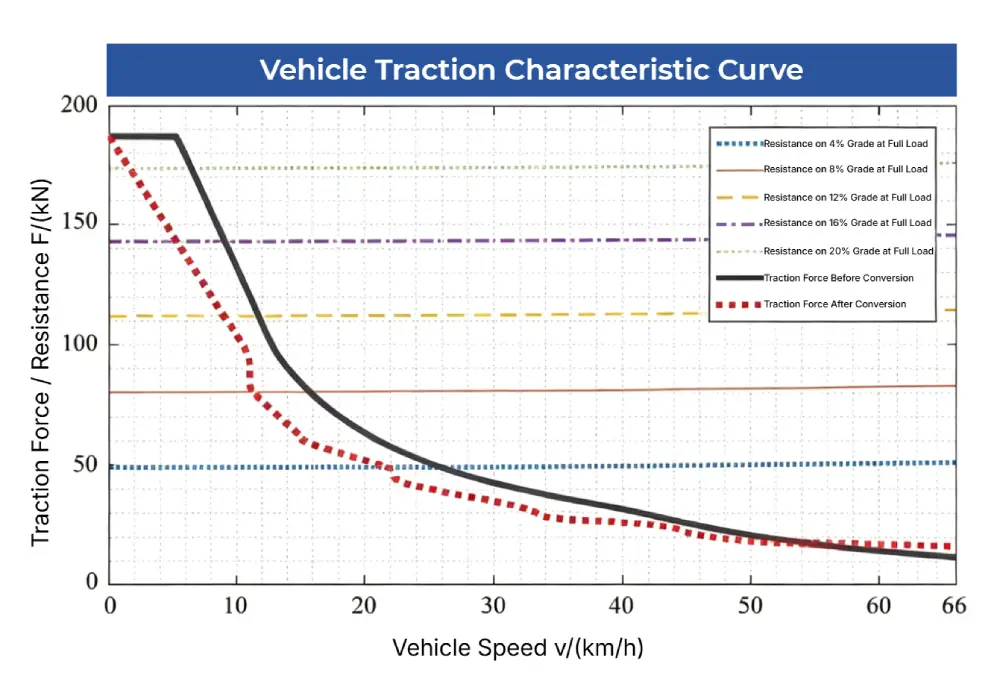
On an 8% grade, the vehicle can maintain a stable speed of approximately 15 km/h, meeting the design requirement of no less than 13.5 km/h.
After the mining truck electrification, the vehicle’s traction force is not lower than that of the original vehicle. The continuously variable speed control also provides smoother operation.
Electric Braking Performance
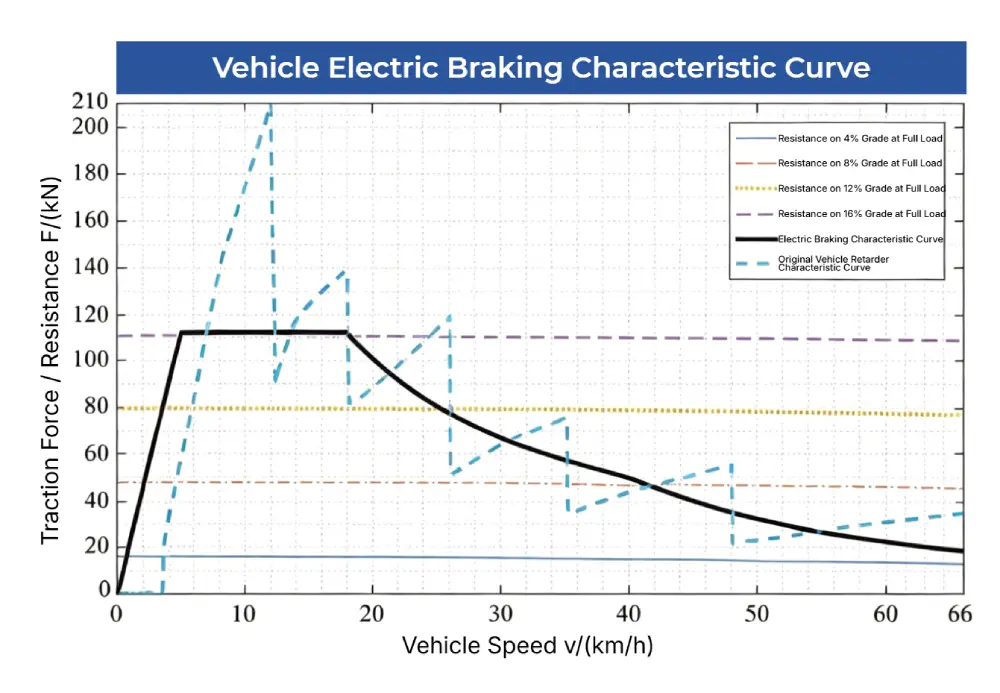
As shown in the figure, when the vehicle is fully loaded on an 8% downhill grade, the electric braking force can maintain a stable vehicle speed of approximately 40 km/h.
When fully loaded on a 16% downhill grade, the electric braking force is greater than the downhill force when the vehicle is traveling at 5–18 km/h.
These results meet the vehicle’s service braking requirements. During operation, electric braking can be used as the primary braking method, substantially reducing the use of mechanical brakes, reducing mechanical brake wear, and further lowering brake system maintenance costs.
3. Mining Truck Electrification: Energy Consumption Comparison
The energy consumption of the electric dump truck was compared with the original diesel vehicle under loaded downhill and loaded uphill conditions.
For the original diesel truck, fuel consumption was calculated using a reference value of 0.15 kg of diesel per ton.
Loaded Downhill Route
The one-way route was approximately 1.8 km, consisting of:
- 1.13 km of loaded downhill travel
- 0.40 km of level travel
- 0.17 km of loaded uphill travel
The average gradient was approximately 3.72%.
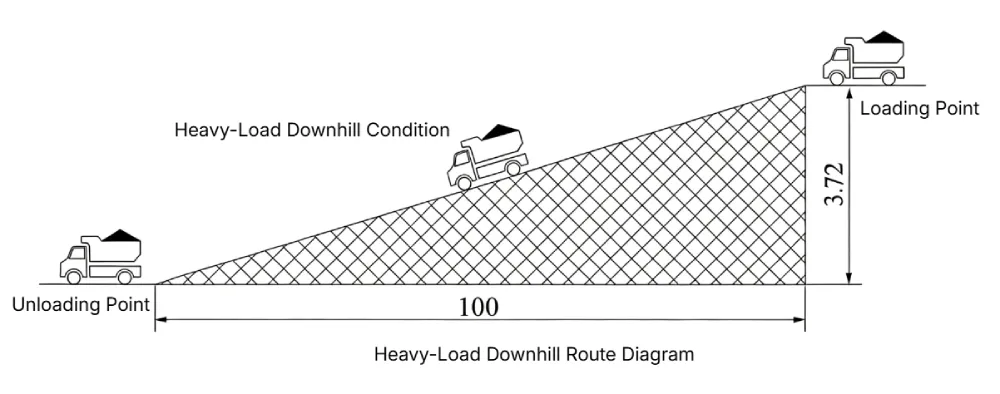
Under the analyzed operating conditions, the electric dump truck could reduce energy costs by approximately 88% compared with the diesel truck.
| Statistical Period | Number of Trips | Energy Charged | Transport Volume | Energy Consumption |
| Per Shift | 19 | 187.96 kWh | 855 t | 0.2198 kWh/t |
The relatively high reduction was closely related to the downhill section and the opportunity for regenerative braking during loaded descent.
Loaded Uphill Route
The one-way route for the loaded uphill condition was approximately 3.13 km, with an average gradient of approximately 1.66%.
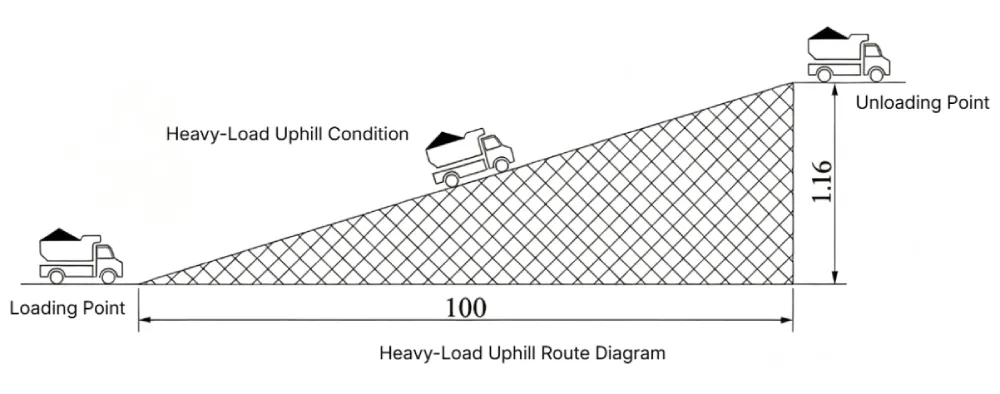
Under these conditions, the estimated energy-cost reduction was approximately 70% compared with the original diesel vehicle.
| Statistical Period | Number of Trips | Energy Charged | Transport Volume | Energy Consumption |
| 27 d | 593 | 14,888.2 kWh | 26,685 t | 0.5579 kWh/t |
The lower reduction compared with the loaded-downhill route shows the influence of route conditions and regenerative braking opportunities on the economics of mining truck electrification.
4. Field Case: 45-Ton Dump Truck Electrification
Two 45-ton diesel mining dump trucks at a cement mine were converted to battery-electric operation.
After commissioning and acceptance, the two vehicles entered regular fleet operation. During nearly two months of operation, vehicle availability was approximately 99%, while transportation efficiency remained broadly comparable with the original diesel trucks.
| Vehicle No. | Number of Trips | Operating Time | Operating Distance | Energy Charged | Transport Volume | Average Energy Consumption |
|---|---|---|---|---|---|---|
| 1# | 1,237 | 496.1 h | 5,330.5 km | 26,094 kWh | 55,665 t | 0.4687 kWh/t |
| 2# | 1,237 | 503.2 h | 5,402 km | 23,571 kWh | 56,565 t | 0.4167 kWh/t |
The vehicles were mainly used on loaded uphill routes, while the proportion of loaded downhill operation was relatively small.
The measured average energy consumption was:
- Electric: 0.4427 kWh/t
- Original diesel: 0.15 kg/t
Based on the energy prices used in the project, the electric trucks achieved an estimated energy-cost reduction of approximately 76% compared with the original diesel trucks.
The one-way transportation distance was approximately 2.15 km.
Charging was arranged during shift changes, meal breaks and after the night shift, avoiding dedicated production downtime for charging.
5. Which Conditions Are Suitable for Mining Truck Electrification?
The case shows that the operating conditions of a mining dump truck have a direct influence on the benefits of mining truck electrification.
Conditions that are more suitable include:
| Operating Condition | Suitable Characteristics |
|---|---|
| Truck type | Mining dump truck |
| Payload | High and relatively consistent |
| Haul cycle | Fixed and repetitive |
| Route profile | Significant elevation difference |
| Loaded travel | Frequent downhill sections |
| Utilization | Long daily operating hours |
| Charging | Available outside production time |
| Existing vehicle | Structurally sound |
Loaded downhill operation is particularly important.
In an open-pit mine with different bench elevations, a fully loaded dump truck descending from a higher level carries considerable gravitational potential energy. During downhill operation, the electric powertrain can recover part of this energy through regenerative braking.
Therefore, mining operations with high payloads, repetitive haul routes and frequent loaded downhill travel can provide favorable conditions for mining truck electrification.
Loaded uphill operation can also benefit from the lower energy consumption of an electric powertrain, but it generally provides fewer opportunities for regenerative braking.
Jenwyn Tech Mining Truck Electrification Solutions
Jenwyn Tech supplies electric powertrain systems for mining dump trucks, including traction motors, motor controllers, EV range extender systems and related auxiliary systems.
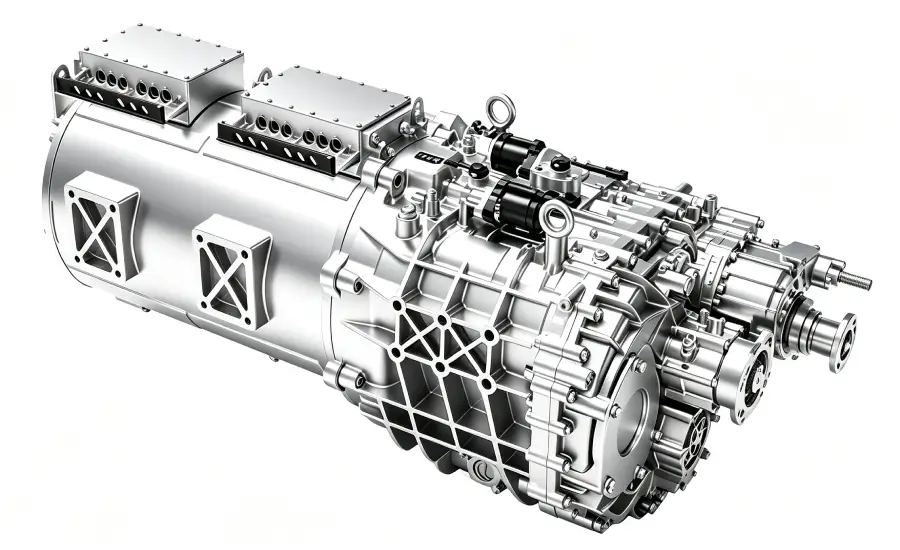
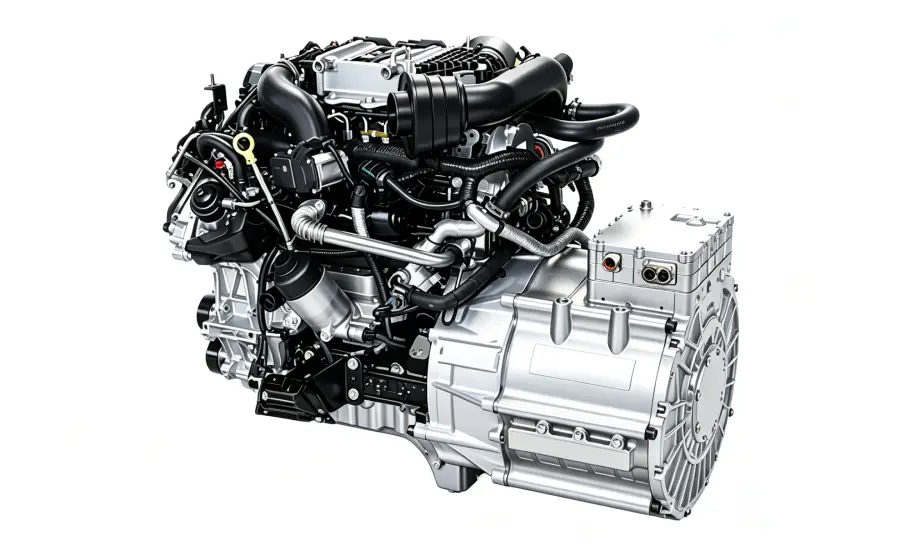
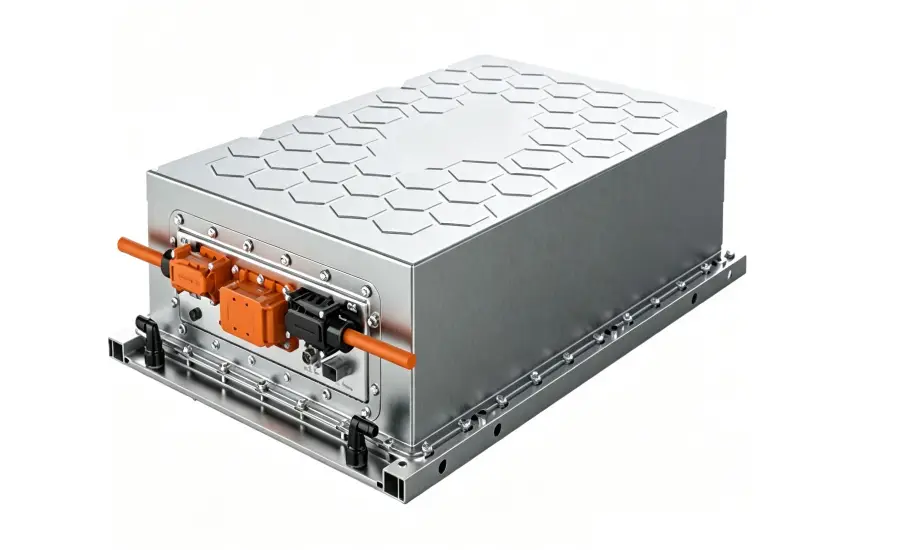
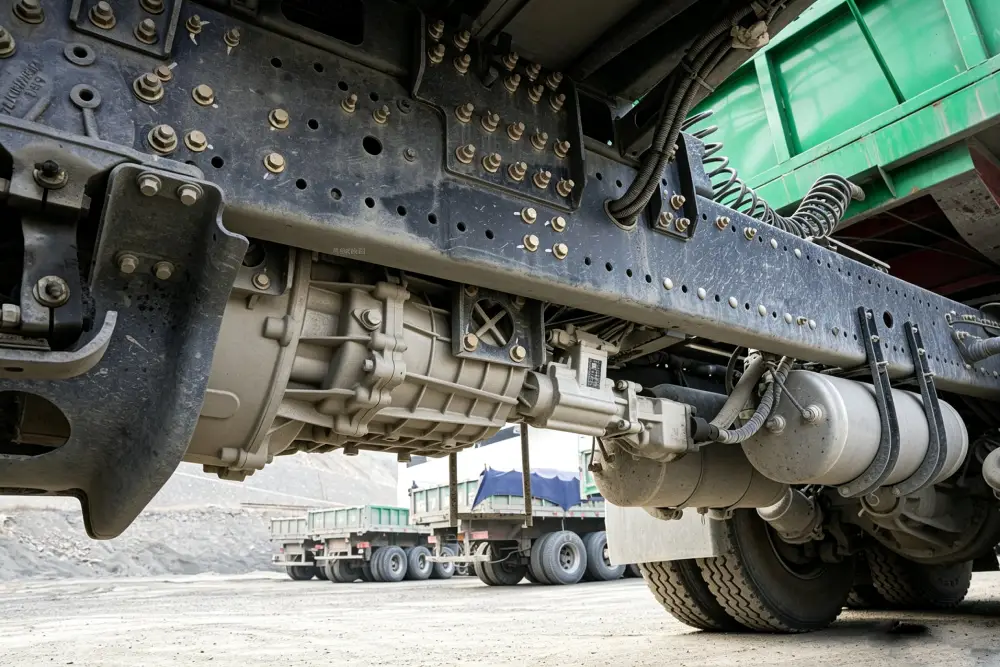
Data-driven engineering methods and simulation-based development processes are applied to optimize electric powertrain systems for demanding mining truck applications. By combining real-world operating data collection, load spectrum analysis and CAE simulation, system strength, transmission durability and structural reliability are evaluated throughout the development process.
- Explore our mining truck ev powertrain solutions: https://jenwyntech.com/solutions/mining-truck-electric-powertrain/
- For project inquiries and technical discussions, please contact contact@jenwyntech.com