
Rated power vs. peak power in an electric motor describes two different aspects of motor output. Rated motor power refers to output under defined operating conditions, while peak motor power is a higher output available for a limited period. For commercial EV developers, both rated and peak power matter—but neither should be evaluated without torque, speed, thermal limits and the vehicle duty cycle.
Rated Motor Power: What It Means for Commercial EVs
Rated power is the motor’s specified output under its defined rated operating conditions. It helps engineers assess whether the motor can support sustained driving demands, such as maintaining speed under load or operating on a long gradient.
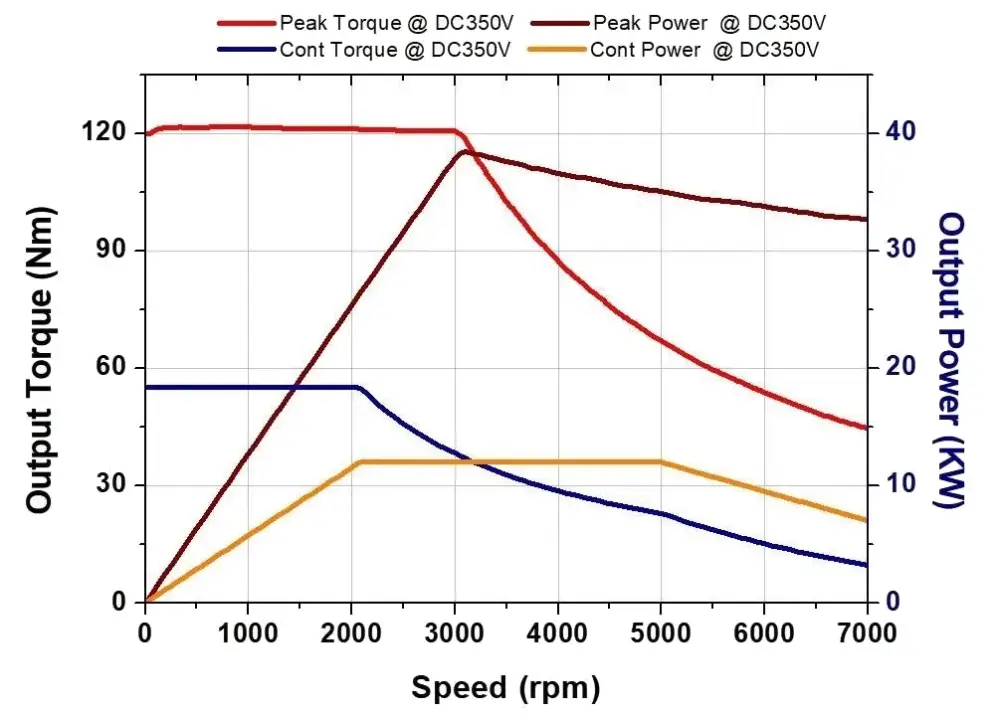
The exact conditions behind a rating matter. Voltage, rotational speed, cooling conditions and temperature can affect the output a motor can maintain. When comparing specifications, make sure the values use comparable test and operating conditions.
Peak Motor Power: Output and Duration
Peak power is the higher output that a motor can provide for a limited period. It may be relevant during vehicle launch, acceleration, overtaking or a short climb. Peak output is not necessarily available continuously, and the allowable duration can depend on thermal state, controller limits and the motor’s operating conditions.
A larger difference between rated and peak power does not automatically mean better vehicle performance. The key question is whether the available peak output and its duration match the actual vehicle requirement.
Why the difference matters for commercial vehicles
Commercial vehicles often operate with substantial payloads and repeated or sustained high-load events. A delivery truck, bus and heavy-duty work vehicle can have very different load profiles. If selection is based only on peak power, a vehicle may meet a short acceleration target but fail to deliver the expected performance during a long climb or extended high-load operation.
Rated power is therefore important when evaluating sustained performance. Peak power remains relevant for transient events, but its duration and recovery conditions should be understood.
Rated Power vs. Peak Power: Key Differences for Electric Motors
| Specification | Rated power | Peak power |
|---|---|---|
| Main purpose | Indicates output under defined rated conditions | Indicates higher short-duration output |
| Most relevant for | Sustained operation and continuous load | Launch, acceleration and transient high-load events |
| Key questions | Can the motor maintain the required output? Under what conditions? | How much output is available, and for how long? |
| What to verify | Cooling, operating speed, voltage and rated conditions | Duration, thermal state, controller limits and repeatability |
| Common mistake | Treating the rating as independent of operating conditions | Assuming peak output is continuously available |
How to Compare Rated Power and Peak Electric Motor Power
- Check the conditions behind each rating. Confirm the rated voltage range, rotational speed, cooling arrangement and test conditions.
- Review the torque-speed curve. Power is not constant at every motor speed. The vehicle needs sufficient torque in the relevant operating region.
- Match the rating to the duty cycle. Identify how long the vehicle must sustain high output and how often peak demand occurs.
- Check the full drive system. The controller, transmission or eAxle, battery and thermal system must all support the intended operating points.
- Validate at system level. Component ratings alone do not establish vehicle performance. Vehicle mass, tires, gearing, road gradient and control calibration also affect the result.
Example: evaluating an electric truck motor
Suppose two candidate motors show similar peak-power values but different rated power. The motor with the higher peak number is not automatically the better choice for a truck that spends long periods climbing under load. Engineers should compare sustained power, torque at the relevant speed, cooling capacity and the time limits associated with peak output.
This is a selection principle, not a universal ranking: the correct motor depends on the vehicle’s performance targets and operating cycle.
What to ask a supplier
Request the rated and peak power definitions, torque-speed curve, peak duration, cooling requirements, voltage range and applicable validation information. If the motor is part of an integrated eAxle or central drive, evaluate the complete assembly rather than treating the motor as an isolated component.
FAQ
Is rated power the same as continuous power?
The terms are often used together, but the supplier’s definition and specified operating conditions should be checked. Do not assume that ratings from different datasheets are directly comparable.
Does higher peak power always improve acceleration?
Not necessarily. Acceleration also depends on torque delivery, vehicle mass, gearing, traction, battery output and controller limits.
Which value should OEMs prioritize?
Neither in isolation. Prioritize the value that matches the operating requirement, and verify both sustained and short-duration performance.
Looking for an EV system solution?
Jenwyn Tech supplies EV traction motors, integrated central electric drive units, and other commercial vehicle drive solutions. For an application review, provide the vehicle weight, payload, target speed, gradients and duty cycle so that the required continuous and transient output can be evaluated together.
You can get in touch with our team at contact@jenwyntech.com or fill in the form below.