
Selecting an electric garbage truck chassis is one of the first decisions in developing a complete waste collection vehicle. The chassis determines the available payload, axle-load capacity, battery installation space and interfaces for the refuse collection body. If these factors are not considered at the beginning, changes to the body structure, hydraulic system or electrical connections may increase development time and modification costs.
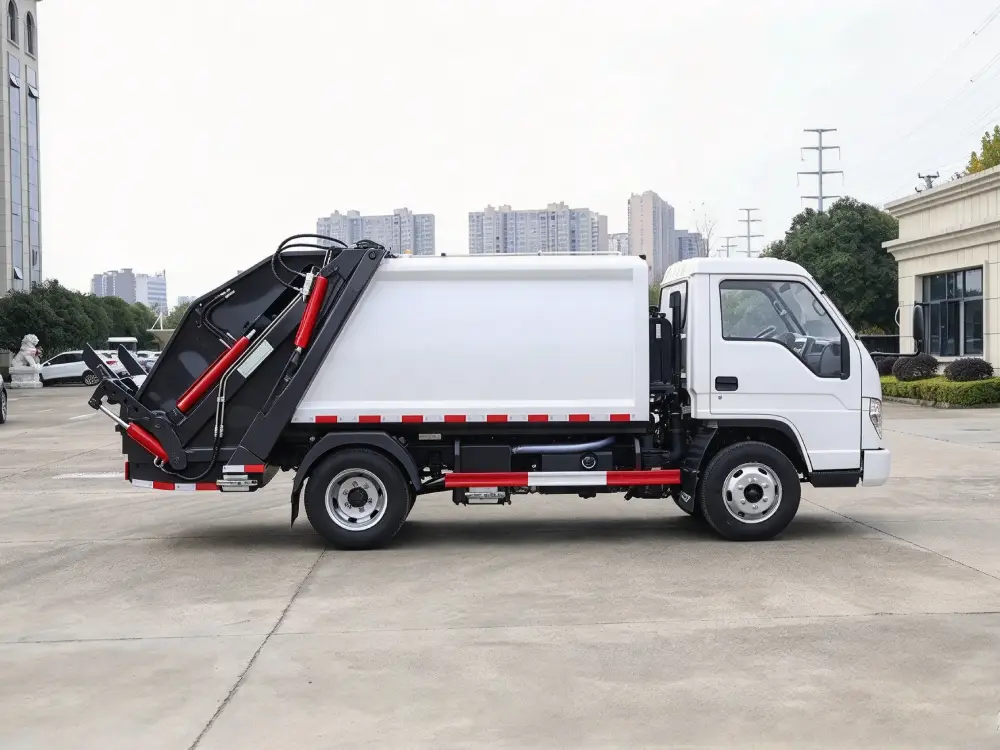
For a 4.5-tonne electric garbage truck, the main considerations include vehicle weight, wheelbase, battery layout, drive configuration and the connection between the chassis and body equipment. The following sections explain nine key aspects of chassis selection, using typical configurations and technical data from the market as reference points.
1. Why Chassis Selection Determines Vehicle Configuration
A 4.5-tonne electric garbage truck is a light-duty special-purpose vehicle in the Chinese market. In relevant Chinese blue-plate light-truck applications, 4,495 kg is commonly used as a design reference below the 4.5-tonne threshold. The exact permitted gross vehicle weight must still be confirmed against the vehicle’s approval and registration requirements.
This figure is not a universal weight limit for overseas markets. Vehicle categories and permissible weights vary by country. For example, a 4.5-tonne goods vehicle generally falls into the N2 category in the European Union, where N2 covers vehicles above 3.5 tonnes and up to 12 tonnes.
Chassis selection directly affects four important aspects of the vehicle.
1. Curb Weight and Available Payload
The chassis weight determines how much of the permitted gross vehicle weight remains available for the body, equipment, occupants and collected waste.
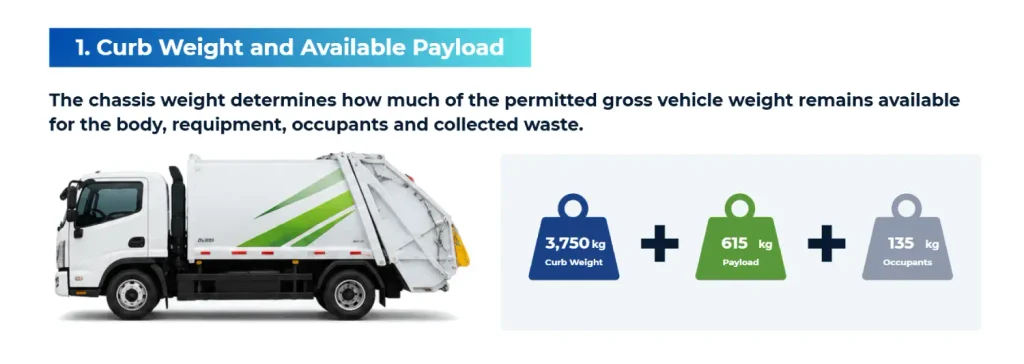
For example, a published 4.5-tonne-class electric garbage truck configuration lists a curb weight of 3,750 kg and a rated payload of 615 kg. This illustrates the limited weight allowance available for the refuse body and collection equipment in some compact vehicle configurations.
2. Wheelbase
Electric garbage trucks used in residential areas and urban streets need to balance maneuverability, body installation space and driving stability.
Wheelbases of approximately 2,800–3,000 mm are common reference dimensions in the Chinese 4.5-tonne-class configurations discussed in this article.
A longer wheelbase may make it harder to maneuver in older residential communities and narrow streets. A shorter wheelbase provides a more compact layout, but its effect on stability, body space and axle-load distribution must also be evaluated.
3. Battery Layout
Battery installation affects available body space, vehicle centre of gravity and axle-load distribution.
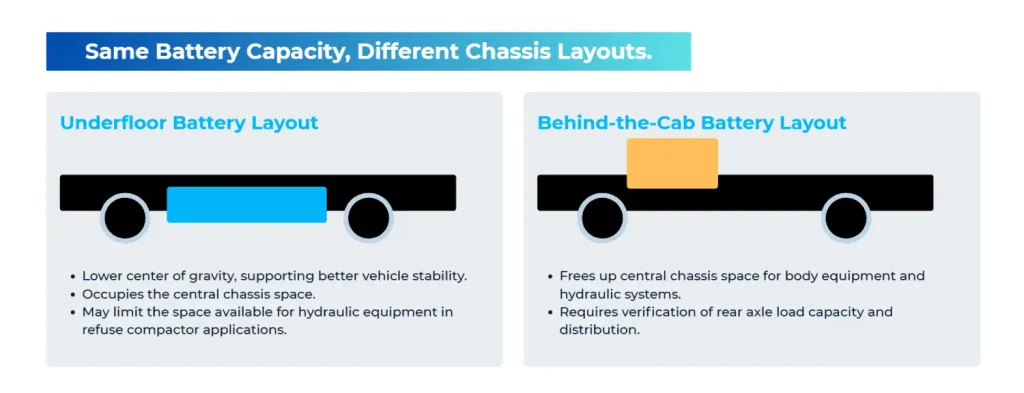
A chassis with an underfloor battery layout may have a lower centre of gravity, while a rear-mounted battery can free up space in the middle of the frame. However, the latter may increase rear axle loading.
4. Power and Communication Interfaces
The chassis must provide suitable interfaces for the refuse body and its auxiliary equipment.
These may include:
- Electrical power supply for auxiliary equipment
- High-voltage power connections
- CAN communication
- Hydraulic pump drive arrangements
- Body operating-status signals and fault information
If these interfaces are not considered during chassis selection, additional wiring, structural modifications and control-system adjustments may be required later.
2. Three Common Mistakes in Electric Garbage Truck Chassis Selection
Mistake 1: Focusing on Battery Capacity Without Checking Battery Layout
Two vehicles with the same 56 kWh battery capacity can have different chassis and body configurations depending on where the battery is installed.
Underfloor battery layout
- Helps keep the centre of gravity low.
- Can improve vehicle stability.
- Occupies space in the middle or lower section of the chassis frame.
Rear-mounted battery layout
- Can release central frame space for body equipment.
- May shift the centre of gravity rearward.
- Can increase the load carried by the rear axle.

For a rear-loading compactor that needs space for hydraulic equipment around the middle of the chassis, battery packaging can be a key factor in determining whether the body can be installed as planned.
Mistake 2: Looking at Motor Power Without Checking Rear Axle Capacity
A higher motor power rating does not establish how much weight the vehicle can carry. The rated capacity of the rear axle is a key constraint in many refuse truck configurations.
One published self-loading refuse truck configuration lists an axle-load distribution of:
- Front axle: 1,500 kg
- Rear axle: 2,995 kg
The rear axle carries almost twice the load of the front axle in this example.
When selecting a chassis, the rated rear axle capacity must be checked against the calculated rear axle load under the fully loaded operating condition. The body, collected waste, battery and auxiliary equipment all contribute to this load.
Mistake 3: Overlooking Body Power and Communication Interfaces
Traditional internal-combustion truck chassis often use a transmission-mounted power take-off (PTO) to drive a hydraulic pump. A battery-electric chassis has a different powertrain arrangement, so the auxiliary power supply needs to be planned separately.
Possible arrangements include:
- An independently driven electric hydraulic pump
- A dedicated high-voltage power supply for auxiliary equipment
The chassis and body also need compatible interfaces for CAN communication, body operating-status monitoring and fault diagnosis.

Confirming these requirements before finalizing the chassis specification helps avoid additional wiring, structural changes and control-system modifications after production.
3. Five Core Dimensions for Electric Garbage Truck Chassis Selection
The following table summarizes five key dimensions and the corresponding reference values from the 4.5-tonne-class configurations discussed in this article.
| Selection dimension | Key parameters | Reference considerations |
|---|---|---|
| GVW and axle loads | Chinese-market 4,495 kg reference; front axle load allocation of at least 25% as an initial design reference | Rear axle rated capacity must cover the calculated fully loaded rear axle load |
| Wheelbase | Approximately 2,800–3,000 mm | A shorter wheelbase, such as 2,800 mm, can be considered for narrow urban streets |
| Drive configuration | 4×2 rear-wheel drive | A gradeability target of at least 25% is listed in the source configurations |
| Battery system | LFP battery, approximately 53–82 kWh | Underfloor or side-mounted layouts can be evaluated to preserve body installation space |
| Body interfaces | High-voltage power, CAN communication and hydraulic pump drive | Confirm the required interfaces during chassis configuration |
The appropriate GVW, axle-load distribution, gradeability and battery capacity depend on the vehicle application and destination-market requirements.
There is no single chassis configuration suitable for every refuse collection vehicle. The appropriate choice depends on the body type, operating conditions and weight distribution.
4. Comparison of Typical 4.5-Tonne Electric Garbage Truck Chassis Configurations
Publicly available product information and industry reports describe several configurations in the 4.5-tonne electric garbage truck segment. The following comparison removes manufacturer names and focuses on their technical characteristics.
| Configuration | Main technical characteristics | Potential application reference |
|---|---|---|
| Configuration A | Front 3-leaf and rear 5+2-leaf steel spring suspension; 185R15LT 8PR or 6.00R15LT 10PR tyres; 50 kW rated motor power; 110 kW peak power; maximum speed 80 km/h; LFP battery options | Urban refuse collection requiring frequent starts and stops |
| Configuration B | 2,800 mm wheelbase; 56 kWh LFP battery; 90 kW peak traction motor power; 7 kW rated power for body equipment | Rear-loading compactor applications |
| Configuration C | 3,000 mm wheelbase; 66 kWh LFP battery; reported chassis operating range of 260 km; 15 kW rated power for body equipment | Self-loading and self-dumping refuse collection |
| Configuration D | 2,850 mm wheelbase; 53.58 kWh LFP battery; 130 kW permanent-magnet synchronous motor; 4,495 kg GVW | Bin collection, with a reported capacity of 15 standard 240 L bins or 28 standard 120 L bins |
5. Chassis Matching for Four Types of Electric Garbage Truck
Different refuse collection bodies place different demands on the chassis. The following configurations provide reference points for matching the chassis to the body type.
5.1 Rear-Loading Compactor Truck
For a rear-loading compactor, rear axle capacity and hydraulic system power are key considerations.
The refuse body, compaction mechanism and collected waste can place substantial loads on the rear section of the chassis. The layout must also provide sufficient space for the hydraulic equipment.
A reference configuration includes:
- Wheelbase: 2,800 mm
- Peak traction motor power: 90 kW
- Battery capacity: 56 kWh
Selection priorities: Rear axle capacity, hydraulic power supply and available installation space.
5.2 Automated Side Loader
For automated side loaders, the chassis needs to support both vehicle movement and the operation of the loading mechanism.
Two published configuration references include:
- 3,000 mm wheelbase, 70 kW traction motor and 66 kWh battery
- 2,800 mm wheelbase, 110 kW motor and 57.6 kWh battery
The final selection should consider the vehicle’s fully loaded performance, loading cycle and auxiliary equipment power demand.
Selection priorities: Traction performance, loading mechanism power and operating range.
5.3 Bin-Collection Refuse Truck
Bin-collection vehicles often operate on short urban routes with frequent stops and repeated container handling.
A compact chassis can help the vehicle maneuver through residential streets. The vehicle should also have sufficient traction response and battery capacity for its daily collection route.
One reference configuration includes:
- Wheelbase: 2,850 mm
- Motor power: 130 kW
- Battery capacity: 53.58 kWh
- Reported capacity: 15 standard 240 L bins or 28 standard 120 L bins
Selection priorities: Compact dimensions, maneuverability, vehicle weight and frequent stop-start operation.
5.4 Hooklift / Skip-Loader Refuse Truck
A hooklift or skip-loader vehicle needs a chassis that can support the container, lifting mechanism and associated operating loads.
The body and container arrangement should be checked against the chassis frame strength, rear axle capacity and overall weight distribution.
One published configuration lists:
- Wheelbase: 2,850 mm
- Motor power: 110 kW
- Rated payload: up to 2,165 kg
The actual payload available will depend on the complete vehicle weight, body mass, lifting equipment and applicable GVW limit.
Selection priorities: Chassis load capacity, frame strength, axle ratings and compatibility with the container system.
6. Axle-Load Distribution and Powertrain Verification
Axle-load distribution should be calculated according to the vehicle’s centre-of-gravity position and wheelbase.
For a simplified two-axle vehicle on level ground:
- Front axle load = Gross vehicle weight × Distance from the center of gravity to the rear axle ÷ Wheelbase
- Rear axle load = Gross vehicle weight × Distance from the center of gravity to the front axle ÷ Wheelbase
The calculation provides an initial static axle-load estimate. The final vehicle design should also consider the load distribution under different operating conditions.
Three Operating Conditions to Check
1. Fully Loaded Transport
When the refuse body is fully loaded, the rear axle may carry its maximum operating load. The calculated rear axle load must remain within the rated capacity of the axle, tyres and related components.
2. Unloading and Lifting
During unloading or lifting operations, the vehicle’s load distribution can change as the body or container moves. For configurations that use lifting equipment, the resulting axle loads and vehicle stability should be checked. Hydraulic support legs should be provided where required by the body design and operating conditions.
3. Empty Vehicle Transfer
The front axle should retain sufficient load for steering and braking performance. A front axle load of at least 25% of total vehicle weight is included as a reference in the source material. This should be treated as an initial design reference, not a universal regulatory requirement.
7. Regulations and Compliance Requirements
Vehicle weight limits, battery safety requirements and special-purpose vehicle approval rules vary by market. The Chinese regulations and standards below are relevant to domestic vehicle development, but they should not be presented as international requirements.
Chinese Standards and Requirements
QC/T 1087-2017 — Technical Conditions for Pure Electric Urban Sanitation Vehicles
This Chinese automotive industry standard specifies technical conditions and test requirements for pure electric urban sanitation vehicles. It is part of China’s industry standards framework.
GB 38031-2025 — Electric Vehicle Traction Battery Safety Requirements
This Chinese mandatory national standard was published on 28 March 2025 and took effect on 1 July 2026, replacing GB 38031-2020. It applies within China’s regulatory framework for traction battery safety.
General Compliance Checks
Regardless of market, the completed vehicle should be checked for:
- Compliance with the approved GVW and axle-load ratings
- Overall vehicle dimensions
- Braking system and ABS requirements, where applicable
- Required protective devices and safety equipment
- Battery and high-voltage electrical safety
- Special-purpose body and equipment approval
- Required vehicle markings and identification
The exact requirements depend on the destination market and the vehicle’s approval route. Chassis and body manufacturers should confirm them before finalizing the vehicle specification.
8. Chassis and Body Integration in Electric Garbage Truck Development
In a conventional development process, the chassis and refuse body may be purchased separately. The body manufacturer then needs to coordinate frame modifications, wiring, hydraulic connections and control-system integration.
For electric refuse trucks, these interfaces should be considered during the initial chassis design.
An integrated chassis-and-body development approach can coordinate:
- Structural integration: Frame dimensions, body mounting points and reinforcement requirements.
- Electrical integration: High-voltage power supply, low-voltage wiring and electrical protection.
- Control integration: CAN communication, body operating signals and fault diagnosis.
- Thermal management integration: Cooling requirements for the traction system and auxiliary equipment.
- Hydraulic integration: Pump installation, hydraulic lines and equipment power demand.
- Installation space: Reserved space for the refuse body, lifting equipment and other auxiliary systems.
Some published integrated chassis concepts specify approximately 3.5–4.3 m of available conversion space behind the cab, together with electrical and CAN interfaces. This is a configuration-specific example, not a standard dimension for all refuse truck chassis.
Integrated development can reduce repeated modifications and make the interfaces between the chassis and body easier to define and verify. For OEMs and body manufacturers, it is worth considering chassis platforms that provide clear structural, electrical and control interface information before procurement.
9. Electric Garbage Truck Chassis Selection Checklist
Before confirming a chassis specification, review these six questions:
- Is the target GVW compliant with the destination market’s vehicle classification and approval requirements?
- Is the rated rear axle capacity sufficient for the calculated fully loaded rear axle load?
- Does the battery layout leave enough installation space for the refuse body and auxiliary equipment?
- Are the required power supply, hydraulic drive and CAN interfaces available?
- Are the chassis approval documents and technical specifications current?
- Can the chassis and refuse body be developed with coordinated structural, electrical and control interfaces?
A suitable electric refuse truck chassis provides the weight capacity, installation space and system interfaces required by the intended body configuration. Confirming these factors early helps reduce modification work and supports reliable vehicle operation.
Disclaimer: This article is intended for technical reference and does not constitute purchasing advice or a certification statement. Vehicle specifications and performance figures are based on publicly reported configurations and should be verified against the latest official approval documents. Applicable regulations and technical requirements must be checked for each destination market.
Jenwyn’s 4.5-Tonne Electric Chassis for Refuse Collection Applications
Jenwyn Tech’s 4.5-tonne electric chassis provides a configurable platform for compact electric refuse collection vehicles.
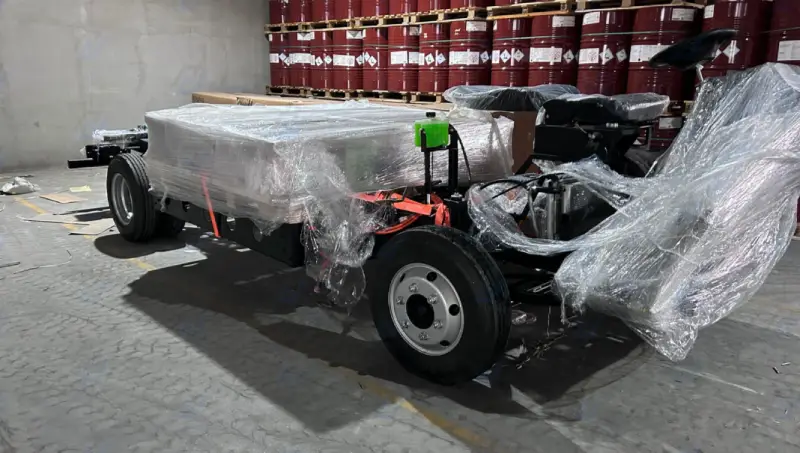
Key Technical Specifications
| Parameter | Specification |
|---|---|
| Gross Vehicle Weight (GVW) | 4,495 kg |
| Chassis Curb Weight | Up to 2,150 kg |
| Curb Weight with Cargo Box | Up to 2,490 kg |
| Stated Payload | 2,000 kg |
| Front Axle Capacity | 2.3 tonnes |
| Rear Electric Drive Axle | 3.5 tonnes |
| Motor Type | Permanent Magnet Synchronous Motor |
| Rated / Peak Power | 60 / 120 kW |
| Drive Configuration | Rear-Wheel Drive |
| Transmission Ratio | 16.029 |
| Maximum Gradeability | ≥25% |
| Minimum Turning Diameter | ≤10 m |
| Minimum Ground Clearance | 210 mm |
| Wheelbase | 3,360 mm |
| Standard Battery Capacity | 83.06 kWh |
| WLTP Driving Range | ≥280 km |
| SOC Reserve | 15% |
Technical Note: The specifications shown are based on a previous project and are for reference only. Actual specifications may be updated or adjusted according to project requirements. Battery capacity and other components are available in different configurations. Please contact our team to confirm the latest technical details for your application.
Platform Advantages
Integrated Electric Drive System
The 60 kW rated / 120 kW peak motor is paired with a 3.5-tonne integrated electric drive axle. This integrated layout simplifies powertrain configuration and provides a ready basis for electric refuse truck development.
Battery Capacity for Extended Collection Routes
The 83.06 kWh battery configuration offers a stated WLTP range of at least 280 km. Alternative battery capacities can be considered according to daily mileage, operating cycles and charging conditions.
Adaptable to Specialized Vehicle Bodies
The chassis can serve as a platform for different refuse collection body configurations, including compactor bodies, self-loading equipment and bin collection systems. Hydraulic equipment, auxiliary power supply and CAN communication can be addressed during vehicle integration.
Designed for Urban Maneuverability
A 3,360 mm wheelbase, minimum turning diameter of no more than 10 m and minimum ground clearance of 210 mm provide useful dimensional characteristics for operation in residential streets and urban collection areas.
Value for Vehicle Manufacturers
- Lower Development Workload: Start with an established electric chassis and powertrain configuration, reducing the engineering work involved in developing a complete electric platform from scratch.
- Flexible Vehicle Configurations: Adapt the chassis, battery capacity and body integration to different refuse collection vehicle designs and customer requirements.
- More Predictable Integration: Define axle loads, vehicle mass distribution, hydraulic power demand and electrical interfaces during the development stage to support smoother chassis-to-body integration.
- Support for Specialized Vehicle Projects: Develop compactor trucks, self-loading garbage trucks and other electric sanitation vehicles using a common chassis platform.
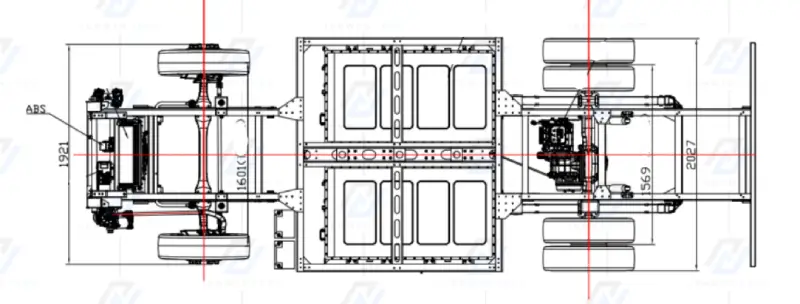
Jenwyn Tech works with OEMs and specialized vehicle manufacturers on chassis configuration, powertrain matching and vehicle integration to support the development of electric refuse collection vehicles for different markets.
You can get in touch with our team at contact@jenwyntech.com or fill in the form below.